




Garage Fans Buying Guide
A useful garage fan is not simply the model with the largest number on the box. The right choice depends on whether you want a breeze at one work position, broader circulation through a two-car space, faster drying after cleaning, or air exhausted outdoors. Those jobs can require different equipment and placement.
This guide explains the practical decisions that matter before you compare current listings. For a direct walkthrough of airflow output, see what size fan a garage needs. If the main problem is stale or hot indoor air, also read the comparison of a garage circulation fan versus an exhaust fan.
Start With the Job, Not Garage Square Footage Alone
Square footage is useful, but it does not describe the entire airflow problem. Ceiling height changes room volume. Parked vehicles, cabinets, shelving, and partition walls interrupt the path of moving air. A fan that produces a strong stream at close range may cool someone at a bench without circulating air through the far bay. Another fan may move a broader column of air more gently.
Define the first job in plain language. “Keep air moving across me while I work at the bench” is a spot-cooling job. “Reduce stagnant pockets throughout the room” is circulation. “Push hot indoor air outside and draw replacement air in” is ventilation. “Move air across a wet floor” is drying. A single portable fan can serve several of these tasks, but it cannot become a true exhaust system merely by facing an open door.
Understand Airflow Ratings in Context
Manufacturers commonly describe fan output in cubic feet per minute, or CFM. That rating helps compare models, but it is not a guarantee of comfort at every distance or an automatic measure of ventilation performance after installation. Blade design, fan diameter, speed setting, grille resistance, direction, distance, and obstacles all affect the air that reaches the work zone.
For person-level cooling, pay attention to airflow reach and adjustability as well as maximum output. For broad circulation, think about how the airstream will travel around vehicles and storage. For a through-wall exhaust fan, ducting, shutters, screens, louvers, and the available path for replacement air can affect delivered flow. Check the installation instructions and ratings for the complete setup rather than treating a headline CFM number as the whole answer.
Portable Floor and Drum Fans
Portable floor fans are flexible choices for garages that change between parking, repairs, hobbies, workouts, and seasonal storage. A compact floor model can aim upward from beneath a bench or across a vehicle bay. A larger drum-style fan can move more air over a wider path, but it also needs clear intake space, stable placement, and room for its cord and frame.
Portability is most valuable when the fan can move without becoming a trip hazard. Check weight, handle placement, base stability, grille protection, tilt range, and whether the controls remain reachable when the fan is aimed. Mark the normal vehicle and walking paths before choosing a resting location. A fan parked in the doorway may work well until someone needs to close the door or move a car.
Pedestal Fans
A pedestal fan raises the airflow above floor-level clutter and can direct air across a bench, seated task, or standing work zone. Height adjustment and oscillation can widen its useful area. The tradeoff is a base that consumes floor space and can be bumped in a busy garage.
Compare the base diameter with the actual open area beside the work zone. Confirm the height-locking mechanism, tilt range, and cord route. Oscillation is helpful only when the sweep reaches useful positions rather than blowing into a cabinet, wall, or stored material for part of every cycle.
Wall-Mounted Fans
Wall mounting protects floor area and can establish a repeatable airflow path over a workbench or along a vehicle bay. It is a strong option when one zone is used regularly and the wall structure supports the installation. The fan must still remain accessible for speed adjustment, inspection, and cleaning.
Before drilling, verify stud or masonry support, fastener requirements, the fan’s full tilt and oscillation envelope, cord reach, and clearance from shelves and overhead doors. Use the manufacturer’s mounting instructions and hardware requirements. Our wall-mount versus floor-fan comparison covers the choice in more detail.
Ceiling Fans and Overhead Clearance
A ceiling fan can improve general circulation without using wall or floor space, but garage ceilings often include openers, tracks, lights, lifts, storage racks, and tall vehicle doors. Blade and mounting clearance must be evaluated with every moving part in its operating position. A ceiling fan also may not provide the focused breeze wanted at a specific bench.
Permanent electrical work and structural mounting should follow the product instructions and applicable requirements. If those tasks are outside your experience, use qualified help. Also coordinate overhead airflow with garage lighting so blades do not create distracting flicker or conflict with fixtures.
Circulation Fans Versus Exhaust Fans
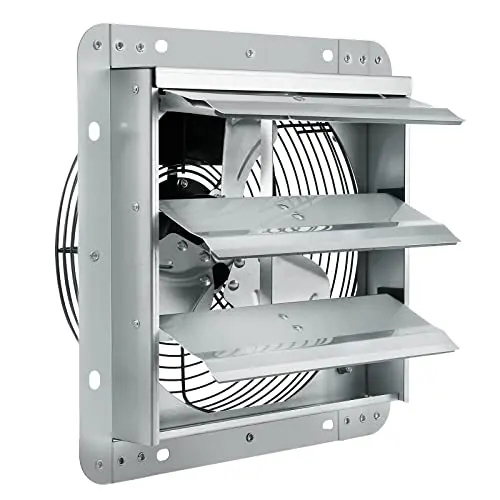
A circulation fan moves air within the garage. Airflow across skin can improve comfort, and moving air can reduce stagnant pockets, but the same indoor air remains in the room. An exhaust fan removes indoor air to the outdoors. For it to work as intended, replacement air must enter from another opening rather than immediately short-circuiting from an opening beside the fan.
Exhaust equipment also requires a suitable wall or opening, weather protection, shutters or louvers when specified, secure mounting, and attention to building and electrical requirements. A portable fan placed near a door may help create a directional path under favorable conditions, but it is not equivalent to a designed exhaust installation.
Neither an ordinary circulation fan nor a basic exhaust fan should be treated as protection against flammable vapors, hazardous dust, vehicle exhaust, or other dangerous contaminants. Control the source, follow product and material instructions, and use ventilation equipment appropriate to the actual hazard. Never run a vehicle in a closed garage.
Build a Useful Airflow Path
Good placement gives moving air somewhere useful to go. For personal cooling, aim through the occupied zone rather than at an empty ceiling or blocked corner. For room circulation, try to carry air along the long dimension of the garage and around major obstructions. For exhaust, establish separated intake and discharge points so replacement air crosses the space.
Openings and outdoor conditions matter. An open shaded door or window may provide cooler intake air in the evening, while afternoon outdoor air can be hotter than the garage interior. Wind can help or oppose the intended path. Test placement at the time of day when the problem is worst. The guide to placing a fan in a hot garage offers several practical layouts.
Planning for a Two-Car Garage
A two-car garage is rarely an empty rectangle. One bay may hold a vehicle while the other contains a bench, cabinets, and storage. A single movable fan can follow the task and provide strong local airflow. Two smaller fans can sometimes distribute air more evenly across separate zones. The better arrangement depends on doors, openings, ceiling height, parked vehicles, and how often the workspace changes.
Do not buy two fans simply because the garage has two bays. First identify the occupied zones and test whether one well-placed unit reaches them. See the two-car garage fan sizing and placement guide for a zone-by-zone approach.
Noise, Controls, and Everyday Use
Noise affects whether a fan stays on during detailed work, phone calls, music, or conversation. Published sound ratings are most meaningful when models are measured under comparable conditions. When ratings are not directly comparable, read the speed options and consider whether a larger fan running below maximum may provide adequate airflow with less perceived noise than a smaller unit at full speed.
Controls should be reachable in the installed position. Multiple speeds, a timer, remote control, tilt, and oscillation can be useful, but each feature should solve a real placement or comfort problem. A simple fan with an accessible switch may be better than a feature-rich model whose controls are hidden behind shelving.
Power and Cord Routing
Check the nameplate and instructions for the fan’s electrical requirements. Route the cord away from vehicle tires, sharp edges, wet areas, hot surfaces, door tracks, and walking paths. Do not pull the fan by its cord or leave a connection where it can be crushed by a garage door or cabinet.
If the supplied cord does not reach, do not improvise. Follow the manufacturer’s directions and applicable electrical guidance for any extension-cord use. A properly located receptacle is often the cleanest solution for a fixed wall-mounted fan. Keep electrical connections dry and stop using damaged cords, plugs, controls, or guards.
Dust, Moisture, and Cleaning Access
Garage fans can collect dust, fibers, and overspray on their guards and blades. Buildup may reduce useful airflow and can contribute to noise or imbalance. Choose a design that can be unplugged, inspected, and cleaned as directed without removing half the surrounding storage.
General-purpose indoor fans are not automatically suitable for damp, wet, dusty, corrosive, or hazardous locations. Check the manufacturer’s environmental limitations and ratings for the exact garage conditions. Keep ordinary fans away from active painting, fuel handling, grinding dust, and other work that creates hazardous airborne material unless the equipment and ventilation plan are specifically appropriate.
Coordinate Comfort With the Rest of the Garage
Airflow works best as part of a usable workspace. Keep the airstream from scattering labels, small fasteners, or dust across the bench. Position workbenches and shop stools so the fan can reach the occupied zone without blocking movement. Use garage floor mats thoughtfully so a portable fan remains stable and cords do not hide along raised edges.
Fans support warm-weather comfort; electric garage heaters address a different seasonal job and have their own clearance and electrical requirements. For more workshop and vehicle-care categories, visit Garage Equipment & Car Care or browse the main Garage Products catalog.
Pre-Purchase Checklist
- Define spot cooling, broad circulation, drying, or exhaust ventilation as the primary job.
- Measure the occupied zone, ceiling height, mounting surface, and full operating clearance.
- Map doors, windows, parked vehicles, cabinets, shelves, and the intended airflow path.
- Compare useful airflow, reach, speed control, tilt, oscillation, noise, and cleaning access.
- Confirm electrical needs, cord routing, mounting hardware, and environmental limitations.
- Plan where a portable fan will sit during use and where it will be stored afterward.
- Use equipment intended for the environment; do not rely on an ordinary fan for hazardous-vapor control.
Garage Fans FAQs
Does a bigger fan always cool a garage better?
No. Diameter and maximum CFM matter, but placement, airflow reach, speed, obstacles, noise, and the intended job determine how useful that airflow feels. A smaller fan aimed through the occupied zone can be more practical than a larger fan that cannot be positioned well.
Will a fan lower the actual temperature in a closed garage?
A circulation fan mainly moves indoor air and can improve comfort through air movement. It does not remove stored heat from a closed room. To exchange hot indoor air for outdoor air, the garage needs a suitable exhaust path and replacement-air opening, and the outdoor air must be favorable.
Where should a garage fan point?
For personal cooling, aim through the work position. For circulation, aim along a clear path that reaches stagnant zones. For assisted air exchange, move air toward a discharge opening while allowing replacement air to enter from a separated location.
Are wall-mounted fans better than floor fans?
Wall-mounted fans save floor space and serve a repeatable zone. Floor fans are easier to reposition for changing tasks. Choose based on the actual work area, mounting support, access for cleaning, and whether portability is valuable.
Can an ordinary garage fan remove vehicle exhaust or flammable fumes?
Do not depend on an ordinary circulation fan for dangerous contaminants or flammable vapors. Prevent the source, follow applicable safety instructions, and use appropriately designed ventilation and qualified guidance for hazardous conditions.
Final Verdict
Choose a garage fan by the airflow job and the physical path, not by square footage or maximum CFM alone. Portable floor and pedestal fans are flexible for changing work zones; wall-mounted models protect floor space; exhaust fans serve a different purpose by moving indoor air outside when installed with a replacement-air path. Measure the real garage with vehicles and storage in place, protect cords and clearances, and favor controls, noise, and cleaning access that make the fan practical to use.
Disclosure:
Compare current garage-fan styles, sizes, and mounting options.
Shop Garage Fans on Amazon