Garage Fan vs Exhaust Fan: What’s the Difference?
Garage Fan vs Exhaust Fan: What’s the Difference?
Quick Answer: A garage circulation fan moves air within the room to improve comfort and reduce stagnant pockets. An exhaust fan discharges indoor air outdoors and needs replacement air to enter. Choose a portable or mounted circulation fan for a breeze and flexible airflow; choose a properly installed exhaust system for planned air exchange.
The word “fan” hides two different systems. A floor, pedestal, drum, ceiling, or wall circulation fan generally keeps the same air moving inside. A shuttered or ducted exhaust fan crosses the building boundary and sends air outside. Understanding that distinction prevents shoppers from expecting personal-cooling equipment to perform a ventilation job it was never designed to do.
Compare garage circulation and exhaust fans on Amazon
At-a-Glance Comparison
| Decision | Best fit | Watch for |
|---|---|---|
| Circulation fan | Moves indoor air through occupied zones | Does not discharge heat or contaminants |
| Exhaust fan | Moves indoor air outdoors | Needs makeup air and proper installation |
| Portable fan at a door | Can assist a temporary airflow path | Weather and wind affect performance |
| Hazard-rated ventilation | Designed for specific dangerous conditions | Requires proper selection and expertise |
What a Circulation Fan Actually Does
A circulation fan creates air movement inside the garage. That movement can make a person feel more comfortable, reduce stagnant pockets, and help dry a damp surface. Portable floor, pedestal, drum, wall-mounted, and ceiling fans can all perform this job in different ways.
Circulation does not guarantee a lower room temperature. Heat stored in the roof, walls, concrete, vehicles, and indoor air remains unless it leaves the space or a cooling system removes it. The fan may mix warmer ceiling air with lower air even while providing a welcome breeze at the bench.
What an Exhaust Fan Does
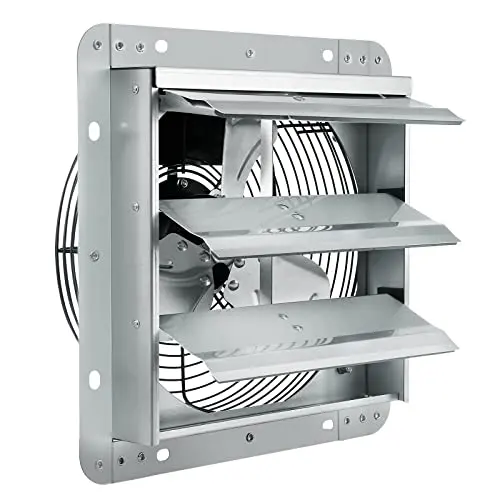
An exhaust fan moves indoor air across the wall or roof to the outdoors. Common garage examples include shutter fans installed through a wall and fans connected to suitable ducts. The opening, shutter, screen, louver, duct, and exterior termination are parts of the airflow system, not decorative accessories.
An exhaust fan cannot move its rated volume if replacement air has no practical way to enter. A door, window, transfer opening, or designed intake must provide makeup air. Place it away from the exhaust so incoming air crosses the garage instead of taking a short route straight back outside.
Review current garage fan types
Comfort Cooling Versus Temperature Reduction
Moving air across skin can improve comfort even when the thermometer barely changes. That makes a circulation fan effective for a person working in one zone. It can also be the more efficient solution when the garage door opens frequently and conditioning the whole volume is impractical.
Exhaust can reduce indoor heat when the outdoor air is cooler and the path removes warmer indoor air. On a very hot afternoon, exhausting indoor air while replacing it with even hotter outdoor air may provide little benefit. Compare indoor and outdoor conditions and consider insulation or shading as part of the heat-control plan.
Temporary Doorway Airflow
A portable fan near an open door or window can assist air movement, particularly when another separated opening supplies replacement air. Positioning the fan a short distance from the opening may help it entrain surrounding air, but the best location depends on the fan, opening, wind, and room geometry.
This arrangement remains temporary. It can block access, expose the fan to weather, create cord hazards, and lose effectiveness when wind or temperature changes. Do not describe it as equivalent to a through-wall exhaust installation.
Compare wall and portable airflow options
Static Resistance and Installed Performance
An exhaust fan works against resistance from shutters, screens, louvers, duct length, bends, and pressure differences. A free-air CFM number may not equal the airflow delivered after all components are installed. Review the manufacturer’s performance data and installation instructions for the intended configuration.
The wall or roof opening must be flashed and weather-protected appropriately, and the fan needs structural and electrical support. Backdraft control may be important when the unit is off. These details make exhaust selection an installation decision as well as a product decision.
Placement and Makeup Air
For general heat removal, a higher exhaust location may take advantage of warmer air near the ceiling, while a lower or opposite-side intake supplies replacement air. The correct arrangement depends on the building, openings, neighboring spaces, and equipment clearances.
Do not pull air from an attached home or from areas with combustion appliances without understanding the pressure and safety implications. If the system can affect fuel-burning equipment, indoor air quality, or code requirements, seek qualified HVAC or building guidance.
Check garage exhaust fan configurations
Hazardous Vapors, Dust, and Vehicle Exhaust
An ordinary circulation fan or general-purpose exhaust fan is not automatically safe for flammable vapor, combustible dust, welding fume, carbon monoxide, or other hazardous contaminants. Motor construction, wiring, airflow rate, capture location, discharge, and makeup air may all require specialized design.
Control the source first. Never run a vehicle in a closed garage. Follow the instructions for fuels, coatings, solvents, tools, and combustion equipment. Use appropriately rated equipment and professional help when hazardous ventilation is involved.
Noise, Controls, and Maintenance
A portable circulation fan usually offers easy speed control and direct cleaning access. A fixed exhaust fan may include shutters, thermostats, speed controls, or remote switching, but every added component must be compatible with the fan and installation.
Clean guards, blades, shutters, and screens as directed. Dust or sticking louvers can reduce airflow. Preserve safe access for maintenance and disconnect power as instructed. Stop using equipment with damaged cords, wiring, mounts, guards, or moving parts.
How to Choose Between Them
Choose circulation when the goal is a breeze at a bench, shared air movement across a bay, or portable drying. Choose exhaust when the goal is to replace indoor air with outdoor air and the building can support a discharge opening plus makeup air. Some garages benefit from both: exhaust for exchange and a smaller circulation fan for the occupied zone.
Do not buy both automatically. Map the airflow path, identify the times and outdoor conditions that cause the problem, and test simple placement first. The right system is the smallest one that reliably performs the defined job.
Fit the Fan Into the Working Garage
Coordinate airflow with the rest of the workspace: browse Garage Fans, keep workbenches and shop stools in the useful air path, and avoid creating conflicts with garage lighting, electric garage heaters, or garage floor mats. The broader Garage Equipment & Car Care hub and Garage Products catalog connect the surrounding workshop categories.
Continue the Garage Airflow Series
Browse garage airflow equipment
Common Category Mistakes
The biggest mistake is buying a high-velocity circulation fan and expecting it to remove heat from a sealed building. It may improve comfort while the stored heat remains. The opposite mistake is installing an exhaust fan when the real need is a quiet breeze at one bench; permanent construction may add cost without improving the occupied zone.
Another error is ignoring makeup air. Exhaust without an intentional intake can deliver less airflow than expected and may pull air from neighboring spaces. Do not select hazardous-location equipment by appearance or a casual keyword match. If fuels, solvents, combustible dust, welding fumes, or combustion gases are involved, the contaminant, capture method, motor and electrical classification, discharge location, and replacement air all matter. That is a design problem requiring appropriate expertise, not a general fan comparison.
Pre-Purchase Checklist
- Write down whether the job is comfort, circulation, drying, or outdoor air exchange.
- Identify a clear indoor path and, for exhaust, a separated makeup-air opening.
- Review installed—not just free-air—performance data.
- Confirm wall, roof, shutter, duct, weather, electrical, and control requirements.
- Plan cleaning access for blades, guards, screens, and louvers.
- Use specialized guidance and rated equipment for hazardous contaminants.
Frequently Asked Questions
Will an exhaust fan cool a garage?
It can exchange hotter indoor air for cooler outdoor air when conditions and makeup air are favorable. It is not mechanical cooling, and it may provide little temperature benefit when outdoor air is hotter.
Can a box fan in a window work as an exhaust fan?
It may assist temporary air movement if safely positioned and protected, but it is not necessarily rated or installed as a permanent exhaust system. Weather, security, support, cord routing, and manufacturer instructions matter.
Does an exhaust fan need an intake vent?
It needs a path for replacement air. Without adequate makeup air, airflow can fall and pressure effects may draw air from unintended locations.
Is a circulation fan enough for car exhaust?
No. Never idle a vehicle in a closed garage. Prevent the source and use appropriate ventilation and safety guidance; an ordinary fan is not carbon-monoxide protection.
Can one wall fan provide both circulation and exhaust?
Only if the product and installation are designed for the chosen function. A fan mounted on an interior wall circulates; a suitable unit installed through the building envelope can exhaust, subject to its ratings and complete airflow path.
Final Verdict
A circulation fan and an exhaust fan solve related but different problems. Use circulation for person-level comfort, flexible airflow, and drying; use exhaust for controlled indoor-to-outdoor air exchange with a deliberate makeup-air path. Evaluate installed resistance, weather protection, structural and electrical work, and maintenance before choosing exhaust equipment. Treat hazardous contaminants as a specialized ventilation problem, never as an ordinary fan purchase.
After choosing circulation or exhaust, continue with the complete garage ventilation and fan selection workflow to map the air path, make-up air, resistance, mounting, electrical conditions, controls, and maintenance.