Garage Ventilation and Fan Selection Guide: Airflow, Exhaust, Placement, and Safety
Quick Answer: Choose a garage fan by naming the job before comparing airflow numbers. Use a circulation fan for personal comfort or air mixing, a planned exhaust system for outdoor air exchange, and task-specific local exhaust for dust, fume, mist, or vapor control. Then verify the airflow path, make-up air, installed resistance, mounting, electrical environment, noise, controls, maintenance, and exact product instructions. An ordinary portable fan is not a substitute for a designed hazardous-process ventilation system.
A garage can feel hot, stale, dusty, or odorous for very different reasons. One product rarely solves all of them. A floor fan can create a useful breeze at a workbench without removing heat or contaminants from the building. An exhaust fan can replace indoor air with outdoor air, but its real delivery depends on the inlet, louvers, screens, ducts, bends, wind, and pressure losses. A capture hood for welding or dust collection is a different system again because it must control material near its source before it spreads through the breathing zone.
This guide provides a complete selection workflow rather than a universal air-changes-per-hour target. Building use, climate, fuel-burning equipment, attached living space, contaminants, local requirements, and the exact fan instructions can change the correct design. My Garage Products is a discovery site; it does not design, install, certify, sell, ship, warranty, authenticate, or process returns for ventilation equipment.
Start With the Airflow Job
| Job | Appropriate starting point | What it does not prove |
|---|---|---|
| Personal cooling | Portable, pedestal, drum, or wall-mounted circulation fan aimed through the occupied zone | That heat, moisture, exhaust, or contaminants leave the garage |
| Whole-room mixing | One or more circulation fans positioned to reduce stagnant pockets | That indoor air has been replaced with cleaner outdoor air |
| Outdoor air exchange | Exhaust fan with a defined discharge and planned make-up-air opening | That a free-air CFM label will be delivered after installation |
| Dust or fume capture | Task-specific local exhaust close to the source, with suitable hood, duct, cleaner, fan, and discharge | That a general room fan can control the exposure |
| Spray or flammable-vapor work | Purpose-designed equipment and professional/code review for the exact process | That a consumer fan is suitable for an ignitable atmosphere |
| Vehicle or engine exhaust | Do not idle engines in an attached garage; use process-specific controls where engine work is permitted | That an open door or fan makes carbon monoxide safe |
Use the Garage Fans collection to compare circulation candidates only after choosing the correct row. For the narrower category distinction, read Garage Fan vs Exhaust Fan. That comparison explains why air movement at your skin and measured air exchange through the building are not interchangeable outcomes.
Separate Comfort From Ventilation
A circulation fan creates air motion. That motion can improve comfort by helping heat leave the body and by reducing a still-air pocket, but the fan does not mechanically refrigerate the garage. In a closed space, the room’s dry-bulb air temperature may remain nearly unchanged even when a person feels cooler. If the outdoor air is cooler or drier, a deliberate intake-to-exhaust path can exchange indoor air and may improve conditions. When outdoor air is hotter, more humid, smoky, or polluted, more exchange can make the garage less comfortable.
Ventilation means supplying, exhausting, or otherwise controlling air for a defined purpose. OSHA’s current ventilation technical manual distinguishes general exhaust, local exhaust, make-up air, HVAC, and recirculation. The manual is written for workplace investigations rather than residential fan shopping, but the distinctions are useful: a comfort fan can mix air without removing a contaminant, while local exhaust is intended to capture an emission at or near its source.
Write one sentence that describes success. Examples include “create a breeze across the east workbench,” “replace hot evening air through the west wall,” or “capture welding fume at the task.” If the sentence names a contaminant, process, fuel, or ignition risk, stop treating the project as a general fan purchase and obtain task-specific guidance.
Map the Intake-to-Exhaust Path
Air needs an entrance, a route through the occupied area, and an exit. Mark the main door, service door, windows, wall vents, attic openings, attached-house door, stairs, combustion appliances, vehicles, shelves, cabinets, overhead racks, and the place people work. Then draw the intended air path. The best path crosses the hot or occupied zone without pulling unwanted air from the home, a crawlspace, an appliance vent, a driveway exhaust plume, or a dusty neighboring process.
Exhaust fans need replacement air. OSHA’s technical manual notes that inadequate make-up air reduces exhaust flow and creates negative pressure. It also explains that make-up air placement affects the control system. For a garage, that means the inlet should be intentional and adequately open rather than depending on cracks under doors. A strong exhaust fan paired with a restrictive inlet may be noisy, underperform, make doors hard to operate, or change pressure relationships with adjacent spaces.
Pressure changes also deserve review when the garage contains or adjoins fuel-burning equipment. A fan system must not interfere with appliance venting or draw combustion products toward occupied areas. Have a qualified HVAC, mechanical, or building professional evaluate uncertain conditions. Never use the door to the house as the planned make-up-air opening.
For a circulation-only layout, use Where Should You Place a Fan in a Hot Garage?. It covers doorway placement, crossflow, short-circuiting, vehicle obstructions, and changes between parked and working configurations.
Use CFM as One Input, Not a Delivered-Air Promise
Cubic feet per minute is useful only when the rating conditions and the proposed installation are understood. A circulation fan’s free-air rating and an exhaust fan’s performance against pressure are not the same comparison. Wall caps, louvers, insect screens, filters, backdraft dampers, duct length, duct size, transitions, elbows, and poorly arranged inlets all add resistance. Dirt accumulation can add more over time.
AMCA’s 2024 system-effect guidance explains that laboratory ratings use controlled inlet and outlet conditions and that turbulence, obstructions, transitions, and duct layout can reduce installed performance, raise noise and vibration, and increase energy use. Compare fan curves or documented performance at the relevant static pressure when the manufacturer supplies them. If the project needs a guaranteed result, have the complete system selected rather than buying from a free-air number alone.
Room volume can still help organize the problem. Multiply garage length by width by average ceiling height to estimate cubic feet. Record the occupied zone as well, because a tall or storage-filled garage can have the same floor area as another garage but a very different air path. The garage fan sizing guide explains how to use volume, throw distance, obstructions, and job type without turning one CFM headline into a promise.
Choose a Format That Fits the Real Garage
A floor or drum-style fan is flexible and easy to aim, but it occupies floor area and can conflict with tires, rolling tools, cords, water, and storage. A pedestal fan raises the air stream and can sweep a larger standing zone, but its base still needs a protected, level position. A wall-mounted fan preserves the floor and can serve a repeatable zone, but the structure, bracket, fasteners, controls, swivel envelope, cord routing, and service access must all be suitable.
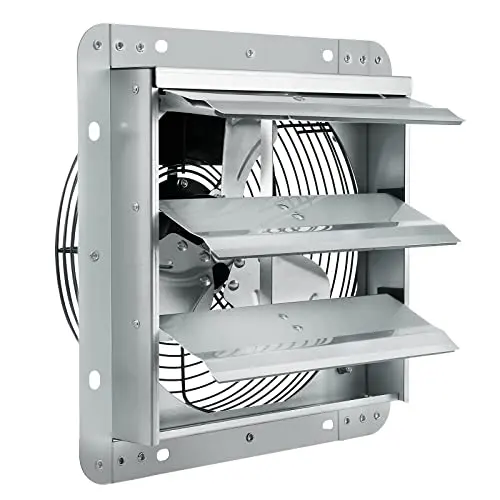
A through-wall or shutter exhaust fan creates an outdoor discharge path, but the wall opening, weather protection, pest screening, louver, backdraft control, make-up air, electrical work, and exterior clearances are part of the system. An inline fan may move the motor and fan body away from the room opening, yet the duct and terminals still impose pressure losses and need maintenance. A ceiling-mounted circulation fan can mix upper and lower air but must clear the garage door, tracks, opener, lights, racks, vehicles, lifts, and raised hoods in every operating position.
Compare mounting choices in Wall-Mount vs Floor Fans for Garages. If the space is a typical two-car layout, Best Garage Fans for a 2-Car Garage provides example zoning and one-fan-versus-two-fan decisions.
Do Not Turn a Comfort Fan Into a Hazard Control
A general fan can disperse dust, mist, or vapor through more of the garage and toward a person’s breathing zone. Local exhaust is designed around the source, hood, duct, air cleaner where needed, fan, discharge, and replacement air. OSHA’s technical manual emphasizes that a hood must be close to the emission source and that blowing air is different from drawing contaminants into a hood. A portable fan across a welding table, grinding bench, finishing area, or chemical task can disrupt an effective capture path.
Spray finishing and flammable-vapor work require especially careful design. OSHA’s current spray-finishing rule requires mechanical ventilation that removes vapors, mists, or powders to a safe location and includes requirements for fan construction, motor location, independent exhaust, discharge, intake air, and continued operation. A home garage is not automatically an OSHA workplace, but the rule shows why an ordinary box, pedestal, wall, or shutter fan should not be assumed suitable for a spraying atmosphere.
Do not rely on airflow to make engine exhaust safe. The CPSC’s current carbon-monoxide guidance says never to leave a car running in an attached garage even with the garage door open. It also states that a CO alarm adds protection but does not replace proper use and upkeep of fuel-burning equipment. A circulation or exhaust fan is not permission to idle a vehicle, run a portable generator, burn charcoal, or operate other prohibited combustion equipment in the garage.
Match the Electrical and Environmental Conditions
Read the exact fan manual before choosing its location. Match the voltage, current, plug or hardwire method, grounding, branch circuit, controls, cord length, permitted orientation, and indoor, outdoor, damp, wet, dusty, or corrosive environment limitations. A heavy-looking metal housing does not prove that the motor, switch, cord, bearings, or enclosure are suitable for moisture, conductive dust, flammable vapor, or outdoor exposure.
Keep portable cords out of tire paths, doorways, standing water, sharp edges, hot surfaces, and retracting equipment. Do not route a cord under a garage floor mat or use an adapter as a substitute for a suitable supply. Fixed wall, ceiling, inline, and through-wall equipment can require structural and electrical work. Use qualified trades and applicable permits when the installation extends beyond the product’s documented consumer setup.
Coordinate fan placement with garage lighting, electric garage heaters, and door hardware. A fan should not block a light, direct dust toward a heater intake, enter a heater clearance zone, or occupy the sweep of a moving door or opener. The Workshop Comfort & Climate hub helps combine these systems around the occupied zone.
Evaluate Noise, Controls, and Operating Behavior
Compare noise at the location where a person will work, not only from across the garage. Fan size, speed, blade design, grille, mounting resonance, duct turbulence, louvers, and obstructions can all affect sound. A variable-speed fan can trade airflow for lower noise during light work, but the control must be compatible with the exact motor and manufacturer instructions.
Review pull chains, switches, remotes, timers, thermostats, humidistats, interlocks, and restart behavior after a power interruption. A remote control is useful only if the physical power state and fan position remain obvious. A timer can prevent needless runtime, but it must not encourage hazardous work without required ventilation. Process ventilation may need to operate before, during, and after the task according to the process design; a convenience timer cannot invent that schedule.
Plan how another household member can shut the fan off without reaching through the grille, stepping into a vehicle path, or climbing around stored objects. Controls should remain visible and accessible after the garage returns to its normal parking and storage configuration.
Plan Cleaning and Seasonal Rechecks
Dust on guards, blades, motors, shutters, screens, filters, and louvers can reduce airflow and increase imbalance or noise. Follow the manufacturer’s de-energizing, cleaning, lubrication, and service instructions. Do not remove guards, bypass interlocks, spray a motor with cleaner, or improvise a replacement control. Stop for a damaged cord, loose mount, bent blade, rubbing, abnormal heat, burning odor, arcing, repeated trips, or a fan that no longer reaches its expected speed.
Recheck the full path at the start of hot weather and whenever storage changes. Seasonal bins can block an intake, exhaust, or service area. A new shelf can create recirculation. A parked truck may interrupt a floor fan’s throw. A sealed winter configuration can remove the make-up-air opening that existed during summer. Clean the system, confirm every fastener and guard, operate each speed, and observe doors, louvers, and dampers before relying on it.
For layout changes beyond ventilation, use the Garage Equipment & Car Care hub and the Garage Organization collection. Fan performance is easier to preserve when the air path is treated as a permanent zone rather than leftover space.
Complete This Selection Worksheet
- Name the outcome: Choose personal cooling, air mixing, outdoor exchange, source capture, or a process-specific system.
- Describe the space: Record dimensions, ceiling height, attached rooms, doors, windows, appliances, storage, vehicles, and work zones.
- Identify hazards: List engines, fuels, finishes, solvents, welding, grinding, dust, moisture, and any combustion equipment.
- Draw the air path: Mark the intended intake, route, exhaust or discharge, and every likely obstruction.
- Plan make-up air: Verify where replacement air will enter without using the house door or disrupting another vented system.
- Estimate volume and resistance: Calculate room volume, then list screens, louvers, dampers, ducts, bends, filters, and terminals.
- Choose the format: Compare floor, pedestal, wall, ceiling, shutter, through-wall, or inline equipment against the real layout.
- Verify the environment: Match electrical supply, mounting, moisture, dust, temperature, and location ratings to the exact manual.
- Audit operation: Check noise, speed control, timer or thermostat logic, restart behavior, access, cleaning, and service parts.
- Reject the wrong tool: Escalate contaminant, flammable-vapor, carbon-monoxide, backdrafting, or code questions to qualified help.
Use workbenches and shop stools to mark where people spend time before choosing the fan height and direction. Comfortable air movement should reach the person without pushing contaminants from a source across the face or through the rest of the garage.
Reject a Fan or Plan When Any of These Are Unresolved
- The job alternates between comfort circulation and contaminant control without separate equipment or procedures.
- The only airflow evidence is a free-air CFM headline for a ducted or restricted installation.
- No make-up-air opening or safe discharge path has been identified.
- The fan could pull air from the attached house or interfere with fuel-burning appliance venting.
- The proposed location conflicts with a garage door, vehicle, lift, heater, light, storage zone, cord path, or wet area.
- The exact manual does not support the mounting orientation, electrical supply, control, or environmental conditions.
- A consumer fan is being treated as protection for spraying, fuel transfer, combustible dust, welding fume, or another hazardous process.
- The plan assumes an open door or fan makes engine exhaust or carbon monoxide safe.
- Guards, shutters, screens, filters, ducts, or service access cannot be inspected and cleaned.
- Important listing, performance, noise, restart, or maintenance claims appear only in seller copy and cannot be matched to product documentation.
Frequently Asked Questions
Will a garage fan lower the room temperature?
A circulation fan mainly moves air and can make a person feel cooler; it does not refrigerate the room. An exhaust setup may lower the indoor temperature when the replacement air is cooler and the path is effective, but it can bring in hotter or more humid air under other conditions.
Is a bigger CFM number always better?
No. The job, air path, throw, room volume, resistance, noise, power, mounting, and controls matter. A ducted exhaust fan must be evaluated at the relevant pressure, while a circulation fan must move useful air through the occupied zone without creating hazards.
Where should make-up air enter?
Place replacement air so it supports the intended sweep through the garage without short-circuiting directly to the exhaust, drawing from the house, or disrupting appliance venting. The exact opening size and location are system-design questions when airflow is substantial or conditions are complex.
Can I use a box fan while spray painting?
Do not assume a consumer box fan is suitable. Spray finishing can involve flammable or harmful vapors, mists, powders, ignition risks, discharge requirements, and specialized equipment. Use a purpose-designed process and obtain applicable professional and code guidance.
Does opening the garage door make vehicle exhaust safe?
No. CPSC says never to leave a car running in an attached garage even with the garage door open. A fan or open door is not a substitute for keeping engine exhaust out of the garage and occupied building.
Should a fan blow toward or away from the workbench?
For comfort-only use, aim useful air through the occupied zone and test for dead spots. If the work releases dust, fume, mist, or vapor, do not improvise with cross-breeze placement; the control should capture material near its source without pulling it across the breathing zone.
How often should I inspect a garage fan?
Inspect before seasonal use, after relocation or impact, and whenever airflow, noise, vibration, heat, smell, or speed changes. Follow the exact manual for cleaning and service intervals, and recheck the intake-to-exhaust path whenever storage or vehicles change.
Final Verdict
The correct garage fan is defined by the airflow job, not the largest blade or CFM number. Use circulation for comfort, a complete intake-and-exhaust plan for air exchange, and source capture for task emissions. Account for make-up air, pressure losses, placement, electrical and environmental limits, noise, controls, and maintenance before comparing convenience features.
Reject any plan that uses ordinary air movement as a substitute for hazard control or carbon-monoxide prevention. Start with the Garage Fans collection for comfort candidates, use the five linked airflow guides for sizing and placement details, and return to the Workshop Comfort & Climate hub to coordinate the fan with heat, light, floor space, and the people using the garage.