Wall-Mount vs Floor Fans for Garages: Which Is Better?
Wall-Mount vs Floor Fans for Garages: Which Is Better?
Quick Answer: Choose a wall-mount fan when floor space is scarce and one fixed airflow path serves the regular work zone. Choose a floor fan when the garage changes tasks and the airflow must move between a bench, vehicle bay, doorway, and drying area. Compare support, clearance, cord routing, noise, controls, cleaning access, and storage—not just CFM.
Wall and floor fans can use similar motors and blade diameters, yet they behave very differently in a working garage. The mounting choice determines whether the fan can follow a task, whether it consumes floor space, how safely the cord is routed, and how easy the unit is to clean. Use the real garage layout to decide which compromise is more useful.
Compare wall-mount and floor garage fans on Amazon
At-a-Glance Comparison
| Decision | Best fit | Watch for |
|---|---|---|
| Wall-mount fan | Fixed bench or bay with limited floor space | Stud support, height and cleaning access |
| Floor fan | Changing tasks and directional drying | Trip paths, storage and stability |
| Pedestal fan | Adjustable person-level airflow | Large base and tip risk |
| Drum fan | Broad high-volume movement | Size, noise and clear inlet space |
The Core Tradeoff: Permanence or Flexibility
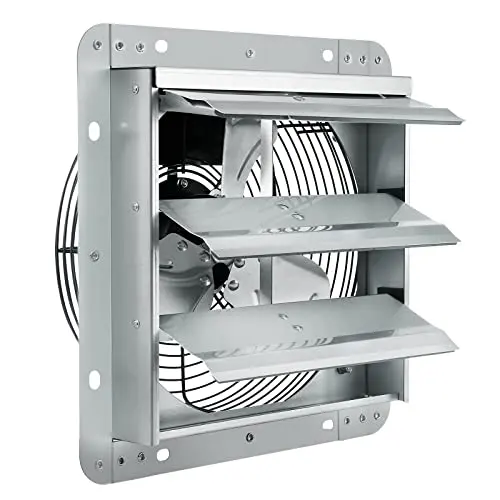
A wall-mounted fan turns one location into a repeatable airflow station. It stays off the floor, cannot be casually carried into a traffic lane, and can aim over a workbench or along a bay. That consistency is valuable when the garage layout and work position rarely change.
A floor fan follows the job. It can cool a person beside a vehicle, move to the open door in the evening, or direct air across a damp floor. Its flexibility costs floor space and creates a cord and frame that must be managed every time it moves.
When Wall Mounting Wins
Choose a wall fan when one bench, exercise area, or service bay is used regularly and nearby floor space is crowded. Elevated placement can clear low cabinets and parked vehicles, and oscillation may share airflow between adjacent positions. A dedicated position also reduces setup time.
The wall must support the fan and dynamic movement specified by the manufacturer. Verify stud or masonry location, bracket hardware, full tilt and oscillation envelope, and distance from shelves, door tracks, lights, and ceiling storage. Permanent wiring or new receptacles may require qualified electrical help.
Review wall-mounted garage fans
When a Floor Fan Is Better
A floor fan is better when there is no single correct airflow path. Garages that alternate between parking, detailing, woodworking, workouts, and storage benefit from a fan that can be aimed and relocated. A compact high-velocity unit can direct air upward; a drum fan can cover a broader route.
Compare handle comfort, weight, wheel design when provided, base stability, tilt locks, guard construction, and cord management. Plan both a use position and a protected storage position. If the fan must live in the center aisle, portability has not solved the layout problem.
Airflow Height and Reach
Wall placement can help air travel above low clutter, but a fan mounted too high may stir ceiling air without creating comfort at body level. Confirm that the tilt range reaches the occupied zone. A floor fan aimed upward may reach the same position, though cabinets or vehicles can interrupt it.
Neither mounting style guarantees whole-room circulation. Diameter, speed, air throw, grille design, distance, and obstacles affect useful reach. Evaluate CFM with those factors and with the speed setting you can tolerate.
Compare portable floor and drum fans
Floor Space, Clearance, and Vehicle Movement
Measure with vehicles parked and doors open. A portable fan beside a tire can be struck during parking; a wall fan above a workbench can conflict with an open cabinet or tall tool chest. The overhead garage door and its tracks add another moving envelope that must remain clear.
Wall fans preserve floor area but occupy vertical storage territory. Floor fans use flexible real estate but can move when the work zone changes. The better option is the one with a dedicated, conflict-free position during normal—not staged—use.
Power, Controls, and Noise
A wall fan’s cord should reach a properly located receptacle without hanging across shelves or work areas. Controls must remain reachable from the floor or through an intended remote control. Do not place a switch where operation requires climbing on a stool or reaching near the grille.
A floor fan can move closer to the user, which may make noise more noticeable. A wall fan may be farther away, but wall and framing vibration can add sound if mounting is poor. Compare speed range and sound information under similar conditions when possible.
Check fan mounting and control options
Cleaning and Maintenance
Both styles accumulate garage dust. A floor unit can be carried to an open cleaning area after it is unplugged, while a wall unit stays in place and needs safe access. Confirm how the guard is removed, what cleaning the instructions allow, and whether fasteners remain reachable.
Inspect mounting hardware, tilt locks, wheels, cords, plugs, guards, and controls. Stop using damaged equipment. General-purpose fans are not automatically rated for damp, corrosive, combustible-dust, or flammable-vapor locations.
A Hybrid Setup Can Be Rational
Some garages benefit from one modest wall fan at the permanent bench and one small portable fan for changing tasks. That is not automatically better than one capable unit; it is useful only when the zones operate independently and the electrical layout supports them.
Test one fan first if possible. A carefully aimed wall unit with oscillation may cover both positions, or a portable fan may prove easy enough to move. Avoid duplicating equipment until the airflow gap is clear.
Fit the Fan Into the Working Garage
Coordinate airflow with the rest of the workspace: browse Garage Fans, keep workbenches and shop stools in the useful air path, and avoid creating conflicts with garage lighting, electric garage heaters, or garage floor mats. The broader Garage Equipment & Car Care hub and Garage Products catalog connect the surrounding workshop categories.
Continue the Garage Airflow Series
Browse garage fan mounting styles
Decision Scenarios
For a narrow one-car bay with a permanent bench, a compact wall fan usually protects the walking lane and removes a repeated setup step. For a two-car garage used for detailing on weekends and exercise during the week, a floor or pedestal fan is more adaptable. For drying a cleaned floor, a low adjustable floor fan can direct air across the surface in a way a high wall unit may not.
In a shared shop, mounting can also prevent one user from moving the only fan away from the main station. In a rental or a garage with unsuitable walls, portability avoids structural changes. If neither option has a safe cord route, solve the electrical location before buying. These scenarios show why the mounting decision should follow the recurring task. Output matters only after the fan can occupy a stable, accessible position.
If the choice remains close, mock up each position with the garage fully occupied. Check whether airflow reaches the user, whether the cord stays protected, and whether cleaning can be done without moving storage. The practical winner usually becomes obvious.
Pre-Purchase Checklist
- Choose fixed coverage or task-to-task portability as the first priority.
- Measure the wall structure, floor position, tilt range, and moving clearances.
- Confirm airflow reaches the occupied zone around parked vehicles.
- Plan receptacles, cord routing, reachable controls, and safe mounting.
- Compare noise at the expected distance and speed.
- Reserve cleaning access and a storage position for portable equipment.
Frequently Asked Questions
Are wall-mounted fans more powerful than floor fans?
Not inherently. Both categories cover a wide range of diameters and outputs. Compare airflow, reach, speed settings, and design for the same intended position.
Can I mount a floor fan on the wall?
Only if the manufacturer specifically provides and approves that mounting method. Do not improvise a bracket for equipment designed to rest on the floor.
Do wall fans need professional installation?
The bracket must be secured to suitable structure and electrical work must be appropriate. Use qualified help when mounting, permanent wiring, or code-sensitive details are outside your experience.
Are drum fans too loud for a garage?
Noise varies by model, size, speed, and distance. A high-output fan may be excessive beside a quiet bench but practical for short-duration drying or broad airflow farther away.
Which type is easier to clean?
Portable fans can often be moved to a convenient location; wall fans avoid floor dirt but require access at height. Follow the specific model’s instructions for guard removal and cleaning.
Final Verdict
Wall-mount fans are strongest for a stable workspace that needs reliable airflow without surrendering floor area. Floor fans are strongest when the garage changes tasks and the airflow must move with it. Decide from the actual use position, structural support, traffic pattern, cord route, controls, noise, and cleaning access. The better fan is the one that remains easy and safe to use after vehicles and storage return.
Put the mounting choice inside the complete garage fan selection process, including circulation versus exhaust, room path, installed resistance, electrical conditions, controls, and hazard screening.