What Size Fan Do I Need for My Garage?
What Size Fan Do I Need for My Garage?
Quick Answer: Choose fan size from the job and airflow path, not square footage alone. A focused floor or pedestal fan can cool one occupied zone; broader circulation depends on room volume, obstructions, throw, and placement. True exhaust ventilation requires outdoor discharge and a separate path for replacement air.
Fan diameter and CFM are useful comparison points, but neither number can describe how air will behave around vehicles, cabinets, ceiling racks, and a person at a bench. Start by naming the job, measuring the three-dimensional space, and deciding where the air needs to begin and end. Then compare models whose controls, noise, power needs, and mounting method fit that plan.
Compare current garage fan sizes on Amazon
At-a-Glance Comparison
| Decision | Best fit | Watch for |
|---|---|---|
| Spot cooling | A focused airstream through one work position | Reach, angle, noise at close range |
| Room circulation | Air movement through several occupied zones | Ceiling height, vehicles and storage |
| Drying | Directed air across a wet surface | Stable placement and electrical safety |
| Exhaust ventilation | Indoor air discharged outdoors | Makeup air, shutters, installation resistance |
Define the Airflow Job First
“Cool the garage” can mean several different things. A fan aimed across a person improves comfort by increasing air movement at the skin, but it may not lower the room’s measured temperature. A circulation setup tries to reduce stagnant pockets by moving air through a longer indoor path. A drying setup puts moving air across a wet floor or cleaned part. An exhaust system removes indoor air from the building. Decide which result matters most before comparing output numbers.
If the garage changes functions, rank the jobs. A movable fan may be ideal when the same bay alternates between vehicle care and workouts. A fixed wall fan can be better when one workbench is used every day. Trying to make one installation perform every job usually produces weak placement.
Measure Volume and the Occupied Zone
Measure length, width, and ceiling height. Room volume matters for whole-space circulation and especially for any ventilation calculation. Then measure the occupied zone: bench height, seated or standing position, distance from a possible fan location, and the vehicle or cabinet that may block the path. A technically large fan cannot help if its stream hits the side of a parked SUV.
Sketch doors, windows, the overhead-door travel, ceiling storage, open shelves, and receptacles. Mark the normal rather than empty-garage layout. This turns fan sizing into a placement problem you can solve instead of a guess based on a one-car or two-car label.
Review garage fan airflow options
Use CFM as a Comparison, Not a Promise
CFM describes air volume moved under stated conditions. It helps compare fans, but delivered airflow depends on speed setting, grille and blade design, direction, distance, and resistance around the installation. A maximum CFM number may be measured on the loudest setting. If you expect to use a lower speed, compare whether the manufacturer publishes output or performance information for that setting.
For an exhaust fan, wall louvers, shutters, screens, and ductwork can add resistance. The system also needs replacement air. Without an intake path, the fan may move much less air than expected or pull air from unwanted gaps. Use the instructions and any performance documentation for the complete configuration.
Match Fan Diameter and Air Throw to Distance
A larger diameter can produce a broader stream, while a compact high-velocity fan may create a narrower, faster jet. Neither is automatically superior. At a close workbench, a small adjustable fan may deliver all the useful airflow needed. Across a long two-car bay, breadth and throw become more important.
Look for tilt or oscillation only when it helps the real layout. Oscillation can share airflow across several positions, but it also means each position receives the breeze only part of the time. A fixed stream is often better for one occupied station or a drying task.
Check current fan diameters and controls
Account for Heat Sources and Timing
A sun-heated garage door, uninsulated roof, vehicle engine, tools, and afternoon outdoor air can all add heat. A circulation fan redistributes that air; it does not remove the heat source. When outdoor air is cooler, a deliberate intake-to-exit path may help exchange heat. When outdoor air is hotter, focused airflow at the person can be more useful than drawing additional hot air indoors.
Test the proposed location at the hour the garage is normally used. Morning and evening conditions may favor open-door airflow, while midday use may require shade, insulation improvements, or localized cooling.
Check Noise, Speed Control, and Power
The fan must be tolerable at the distance where it will operate. Maximum airflow that is too loud for conversation or concentrated work may go unused. Several speeds provide flexibility, and a larger model on a lower setting may sometimes be more comfortable than a smaller unit at maximum. Compare sound data only when measurement conditions are reasonably similar.
Confirm cord length and the intended receptacle before buying. Keep cords away from tires, doors, wet areas, sharp edges, and walking routes. Follow the manufacturer’s electrical directions and stop using damaged cords, plugs, guards, or controls.
Compare portable and mounted garage fans
Know When You Need Exhaust Instead
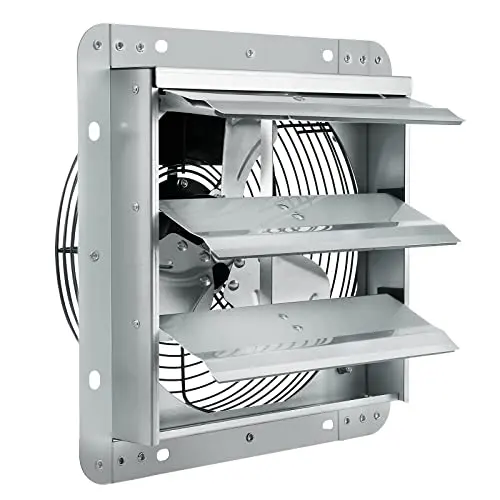
If the objective is to replace hot indoor air, a through-wall or other properly installed exhaust fan may be the correct category. Locate an intake opening away from the discharge so air crosses the garage rather than taking a short loop beside the fan. Weather protection, shutters, structural support, wiring, and local requirements all affect the installation.
An ordinary fan is not protection against carbon monoxide, flammable vapor, hazardous dust, or dangerous fumes. Never run a vehicle in a closed garage. Prevent contaminant sources and use ventilation equipment and professional guidance appropriate to the actual hazard.
Plan Cleaning and Storage
Dust accumulation on guards and blades can reduce performance and contribute to noise or imbalance. Choose a fan that can be unplugged and cleaned according to its instructions without difficult disassembly. Leave access around a wall-mounted unit; do not bury it behind seasonal storage.
For a portable model, reserve a storage location that protects the grille and cord. A fan that blocks the walkway or must be moved from a crowded shelf each time is less likely to be used consistently.
Fit the Fan Into the Working Garage
Coordinate airflow with the rest of the workspace: browse Garage Fans, keep workbenches and shop stools in the useful air path, and avoid creating conflicts with garage lighting, electric garage heaters, or garage floor mats. The broader Garage Equipment & Car Care hub and Garage Products catalog connect the surrounding workshop categories.
Continue the Garage Airflow Series
- Hot-garage fan placement
- Wall-mount versus floor fans
- Fans for a two-car garage
- Circulation fans versus exhaust fans
Browse additional garage fan configurations
Common Fan-Sizing Mistakes
The first mistake is choosing from a garage-size label without checking ceiling height or the occupied zone. The second is comparing maximum CFM while ignoring the speed that will actually be used. The third is treating a circulation rating as an exhaust result. A portable fan can create a strong breeze in a closed room while exchanging no air with outdoors.
Another mistake is solving an insulation or solar-gain problem only with more fan output. If the garage door and roof absorb afternoon sun, shading and insulation may reduce the load more consistently. Finally, do not forget operating clearance. A wide drum fan may fit the open floor but become unusable when a car is parked, while a smaller adjustable fan may retain a clear route to the workbench.
Pre-Purchase Checklist
- Define spot cooling, circulation, drying, or exhaust as the primary job.
- Measure room volume and the occupied airflow zone.
- Map vehicles, cabinets, doors, windows, overhead equipment, and outlets.
- Compare CFM, diameter, reach, speed control, tilt, oscillation, and noise in context.
- Confirm mounting support, cord routing, environmental ratings, and cleaning access.
- Do not use an ordinary fan as hazardous-vapor or vehicle-exhaust control.
Frequently Asked Questions
How many CFM should a garage fan have?
There is no single CFM number for every garage. Spot cooling depends on useful air reaching the person, while ventilation calculations depend on room volume and a target air-exchange rate. Obstacles, distance, and installation resistance also affect results.
Does a two-car garage always need two fans?
No. One movable fan may serve a single occupied zone well. Two fans can help separate zones or build a longer circulation path, but buy the second only when the layout and task justify it.
Is fan diameter more important than CFM?
Both describe different aspects of performance. Diameter can influence the breadth of the airstream, while CFM describes air volume. Blade design, speed, grille, and distance determine how those specifications feel in use.
Can a circulation fan ventilate a closed garage?
No. It moves the air already inside. Actual ventilation requires indoor air to leave and replacement air to enter through a planned path.
Should I oversize a garage fan?
Choose enough capability with useful speed control. Excess output can add noise, draft, size, and power use without improving the regular task.
Final Verdict
Size a garage fan by the result you need and the path air must travel. Measure the occupied zone as carefully as the room, treat CFM as one comparison point, and account for vehicles, ceiling height, noise, controls, and electrical placement. Choose exhaust equipment only when the job is air exchange, and never substitute an ordinary fan for control of hazardous contaminants.
Place the size calculation inside the complete garage ventilation and fan selection workflow, which also separates comfort circulation, outdoor air exchange, source capture, make-up air, installed resistance, and safety limits.