Rolling Shop Stool vs Stationary Shop Stool: Which Is Better?
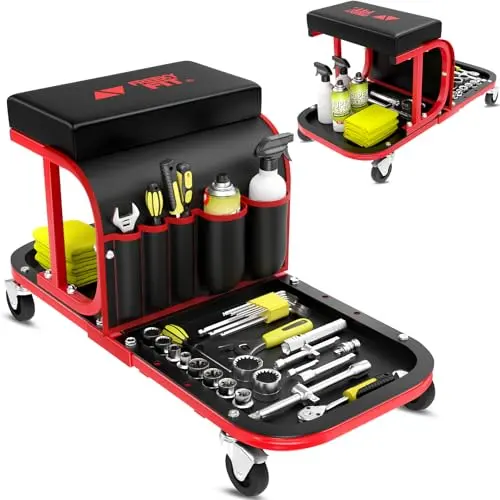
Rolling and stationary shop stools solve different workshop problems. Wheels are valuable when the task moves around a vehicle or along a bench, while fixed feet provide a predictable platform for concentrated work. The best choice depends on floor condition, how often the user changes position, the amount of hand force applied, and where the stool will be stored.
Quick Answer
Choose a rolling stool for frequent low-force movement across a smooth, clean, level floor. Choose a stationary stool for a fixed bench, uneven transitions, or work that benefits from a platform that will not roll. Locking casters can bridge the two roles only if their controls are accessible and the locks hold as the manufacturer specifies.
Compare rolling and stationary shop stools on Amazon after confirming dimensions, capacity, and floor fit.
At-a-Glance Comparison
| Factor | Rolling stool | Stationary stool |
|---|---|---|
| Movement | Easy between nearby tasks | Requires standing or lifting |
| Floor | Needs a clean caster path | Tolerates minor surface texture better |
| Force | May move under push or pull | More predictable at a fixed station |
| Storage | Can roll under a bench | Stays where placed |
Match Mobility to the Work Pattern
A rolling stool earns its space when the user repeatedly shifts a few feet—around a wheel, between drawers, or along a wide project. It can reduce cycles of standing and carrying. If nearly all seated work happens at one vise or bench position, wheels may add complexity without meaningful benefit.
Walk through a normal project and count position changes. Distinguish useful moves from long trips that should happen standing. A stool should support a compact work zone, not become transportation across a crowded garage.
Evaluate the Actual Garage Floor
Smooth sealed concrete is generally friendly to shop-stool casters when it is kept clear. Expansion joints, cracks, pebbled coatings, raised tile edges, and thick mats can stop small wheels. Mark every transition on the intended route and test slowly rather than assuming that a caster described as heavy duty will cross it.
Stationary feet avoid rolling interruptions but still need full contact. A sloped drain area or rocking floor tile can make a fixed stool unstable. Whichever base you choose, all contact points should rest on a firm, level surface.
See current shop stool options on Amazon after confirming dimensions, capacity, and floor fit.
Compare Caster Diameter and Tread
Larger-diameter wheels usually negotiate small seams better, but they raise the base and sometimes the minimum seat height. Hard treads roll freely and resist compression; softer treads may reduce noise and feel more controlled but can pick up debris. Bearing and swivel quality influence whether the stool changes direction smoothly under load.
Check how the casters attach. Threaded stems, grip rings, and mounting plates are not interchangeable merely because dimensions look close. Replacement availability matters because casters are common wear components.
Understand Locks and Brakes
Some caster locks stop wheel rotation, some stop swivel, and some do both. Read the model documentation and confirm the pedal is reachable from the normal seated position without putting fingers near the wheel. A lock that is hard to engage will often go unused.
Even good locks do not turn a rolling stool into an anchor for high-force work. Stand when loosening a resistant fastener or pulling hard against a part. Use the brake to control ordinary seated work, not to compensate for poor technique or a sloped floor.
See current shop stool options on Amazon after confirming dimensions, capacity, and floor fit.
Consider Base Footprint and Approach
Rolling designs often use a circular tray, five-star base, or rectangular frame. Measure the furthest caster-to-caster dimension and compare it with bench legs, cabinets, tires, and jack equipment. The seat may fit under the work while the base cannot approach closely enough.
Stationary stools can use a narrower visual profile, but very narrow or tall designs may be easier to tip during a reach. Base geometry and working height should be evaluated together. Keep the hands within a comfortable zone and reposition rather than leaning beyond the support area.
Compare Comfort During Different Tasks
Rolling stools encourage position changes, which can be helpful during detailing or vehicle-side work. Stationary stools provide a consistent reference point for soldering, assembly, and other fine bench tasks. Seat contour, padding, height, and foot support matter in both categories.
Do not let cushioning decide before function. A plush seat on the wrong base will remain the wrong stool. Choose mobility, working height, and stability first; then compare padding and back support among models that have already passed those tests.
See current shop stool options on Amazon after confirming dimensions, capacity, and floor fit.
When a Hybrid Design Makes Sense
A rolling stool with effective locks can suit a garage that alternates between a vehicle bay and workbench. It rolls for repositioning and can be secured for ordinary bench work. The compromise works best on a smooth floor with controls the user can reach easily.
A heavy stationary stool with glides may also shift short distances when unoccupied, then remain fixed during use. Consider how often movement occurs and whether lifting or dragging is realistic. The hybrid label is useful only if both modes work well in the real space.
Plan Parking and Maintenance
A rolling stool needs a designated parking location outside the vehicle path. A slight floor slope can send an unlocked stool into an aisle or door. A stationary stool needs a storage spot that does not tempt people to leave it where vehicles or carts travel.
Inspect wheels, locks, feet, frame connections, seat mounts, and height controls regularly. Changes in rolling resistance, wobble, squeaks, or seat play deserve attention. Remove a damaged stool from use until model-correct service is completed.
Run a Two-Task Trial on Paper
Choose the two most common seated jobs and sketch where the user, tools, and stool sit during each. Draw the movement path between positions, including cords, floor seams, and cabinet doors. If the path is short and clear, rolling may save effort; if the seat rarely moves, fixed support may be preferable.
Coordinate the decision with workbenches, garage floor mats, and garage floor tiles. A stool chosen without its surrounding floor and furniture can appear correct on paper and fail in daily use.
Pre-Purchase Checklist
- Normal tasks genuinely benefit from rolling or fixed placement
- Full base clears nearby furniture and vehicle equipment
- Casters or feet suit the actual floor
- Locks are accessible and their function is understood
- Seat height matches both tasks
- Capacity covers the complete load
- A safe parking location is reserved
Browse shop stools on Amazon after confirming dimensions, capacity, and floor fit.
Use Movement Only Where It Saves Work
Separate repositioning from travel. A rolling stool is valuable for shifting around one wheel or along a nearby drawer bank, but crossing the garage while seated adds exposure to cords, thresholds, and vehicle paths. Stand for longer moves, park the stool deliberately, and keep its compact work zone clear.
For a stationary model, add felt or improvised glides only if the manufacturer permits them; changing the feet can alter traction and height. If frequent lifting is impractical, a locking rolling design may be the better compromise, provided the locks are accessible and the floor is suitable.
Frequently Asked Questions
Are rolling shop stools less stable?
Not inherently, but they can move and are more sensitive to caster condition and floor debris. Base geometry and use pattern determine the practical result.
Do caster locks make a rolling stool stationary?
They reduce movement according to their design, but they do not make the stool suitable for standing or heavy leverage.
What caster size is best for garage floors?
Use the largest wheel that still preserves the needed seat height and base clearance, then verify it handles the actual seams and transitions.
Can a stationary stool slide on concrete?
Yes. Worn or unsuitable feet can slide, especially on dust or smooth coatings. Inspect floor-contact pads and keep the area clean.
Which style fits a workbench?
A stationary stool is excellent for a fixed station; a locking rolling stool helps when the user shifts between drawers or adjacent tools. Match height and foot support first.
Final Verdict
Rolling stools are best when controlled movement is part of the task and the floor provides a clean caster path. Stationary stools suit fixed work and situations where unexpected movement would be distracting. Measure the full base, inspect the floor, separate high-force tasks from seated work, and choose mobility only when it solves a real workflow problem.
Compare shop stools on Amazon after confirming dimensions, capacity, and floor fit.
Before choosing mobility, use the complete workshop ergonomics audit to map the task, bench approach, caster path, mat transition, storage reach, and a safe place to park the stool during forceful work.