Best Low-Profile Mechanic Stools for Brake and Wheel Work
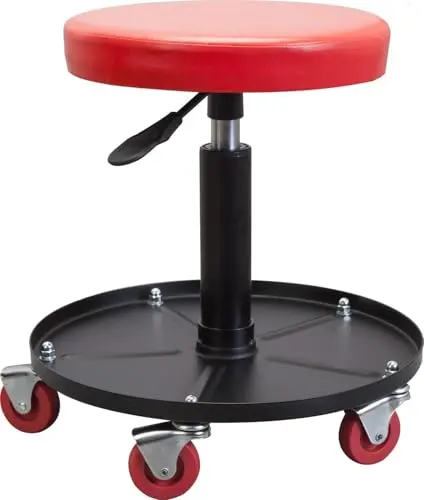
Brake, wheel, detailing, and lower-body work place the hands close to hub height, so a conventional bench stool often leaves the user bending down from above. A low-profile mechanic stool can bring the torso closer to the job, keep commonly used tools nearby, and roll around the vehicle—but only when its height, base, casters, and floor conditions work together.
Quick Answer
For brake and wheel work, start with seat height relative to the hub, then check the complete base diameter, caster size, and clearance around jack stands and tools. Choose a low stool that lets both feet stay planted and the torso face the work. A tray is useful only if it does not block ankle movement or widen the stool into the support equipment.
Compare low-profile mechanic stools on Amazon after confirming dimensions, capacity, and floor fit.
At-a-Glance Comparison
| Decision | What to check | Why it matters |
|---|---|---|
| Working height | Seat top relative to wheel hub | Reduces sustained neck and back bending |
| Base | Full wheel-to-wheel width | Controls approach and stability |
| Casters | Diameter, tread, bearings | Affects seams and debris |
| Tray | Edge height and ankle clearance | Keeps tools close without trapping feet |
Find the Right Height for Hub and Brake Work
Measure from the floor to the center of the wheel hub with the vehicle in its normal service position. The ideal seat does not have to match that number exactly, but it should let the eyes and hands face the assembly without repeated forward folding. Consider how the vehicle changes when raised and supported, because the hub may sit at a different height than it does on the ground.
Test the posture mentally with both feet on the floor and the knees clear of the tire. A seat that is too low can compress the hips and force the knees upward; one that is too high moves the shoulders above the work. If several vehicles are serviced, an adjustable low-range stool may cover more tasks than a fixed-height design.
Measure the Base Around the Vehicle
The seat cushion can look compact while the caster ring or tool tray extends several inches farther in every direction. Measure the full outside dimension and compare it with the space between the tire, lift arm, jack stand, drain pan, and tool cart. The stool must enter and exit the work zone without contacting equipment that supports the vehicle.
A broad base can improve resistance to tipping, but width becomes a problem if it forces the user to sit farther from the hub. Favor a layout that brings the knees close enough for a neutral reach while keeping every caster on clear floor. Never position the stool where it could bump a jack stand or other support.
See current shop stool options on Amazon after confirming dimensions, capacity, and floor fit.
Choose Casters for the Actual Floor
Low stools often use small casters to keep the seat near the floor. Small wheels turn easily on smooth concrete but can stop at expansion joints, floor-tile edges, dropped fasteners, or a thick mat lip. Inspect the route around each wheel bay and sweep before work; a single nut under a caster can turn a controlled roll into an abrupt stop.
Wheel tread also changes behavior. Hard wheels roll freely but transmit more vibration and may be noisy. Softer treads can feel more controlled yet pick up debris or resist swiveling under load. Check whether replacement casters are available and whether the stem or mounting plate is serviceable.
Keep Tools Close Without Creating a Hazard
An under-seat tray is convenient for sockets, brushes, calipers, and small parts used repeatedly. Look for a raised edge that contains tools while rolling, enough clearance to retrieve them without reaching under the seat, and a shape that does not interfere with the heels. A removable tray is easier to clean after greasy work.
Do not use the tray as a permanent dumping place. Loose extensions and heavy sockets can slide to one side, change balance, or fall into a caster. Keep fasteners in a small divided container and return rarely used tools to dedicated garage tool storage. The best tray supports the current task, not the entire toolbox.
See current shop stool options on Amazon after confirming dimensions, capacity, and floor fit.
Compare Seat Shape and Padding
A small round cushion allows rotation but offers limited contact area. A tractor-style or contoured seat can guide position, though its raised edges may restrict quick movement. Very soft foam may feel inviting initially and then compress unevenly during a long brake job. Moderately firm padding generally provides steadier support while the user turns or reaches.
Consider cleanability as carefully as thickness. Vinyl is easy to wipe but can split when sharp parts are placed on it. Molded seats resist many shop messes but provide less cushioning. Keep solvents off the upholstery unless the manufacturer identifies compatible cleaning methods.
Know When a Creeper Seat Is the Wrong Tool
A low rolling stool is designed for seated work beside the vehicle. It is not a creeper for sliding beneath the chassis, a step, or a vehicle support. If the task moves under the vehicle, use purpose-built access equipment and approved support procedures. Do not lean backward on a backless stool to reach beneath a rocker panel.
A kneeling pad may be better when the job is very close to floor level or when the caster base cannot fit around equipment. A taller stool may be better for bodywork or detailing above the hub. Choose the position that keeps the work inside a comfortable reach zone instead of forcing one seat to handle every elevation.
See current shop stool options on Amazon after confirming dimensions, capacity, and floor fit.
Control Movement During Forceful Tasks
Wheel and brake work sometimes involves pushing, pulling, or turning a resistant fastener. A free-rolling stool can move in the opposite direction when force is applied. Plant both feet, keep the hands within the base, and stand for tasks that require significant leverage. Caster locks help only when they are engaged, accessible, and rated to prevent the type of movement involved.
Plan the sequence so high-force operations happen from a stable stance and the stool returns for inspection, cleaning, or reassembly. This separation improves control and keeps the stool from being treated as an anchor point. Never brace the stool against the vehicle, a stand, or another movable object.
Store and Maintain a Low Mechanic Stool
Choose a parking location outside the vehicle path, preferably under a suitable bench or beside a cabinet where the stool cannot roll into an aisle. Measure the parked height with the seat and backrest, if present. A brightly visible edge can make a low stool easier to notice in a busy garage.
Before each session, spin the casters, remove wound thread or wire, check fasteners, and inspect the frame and seat mount. Stop using the stool if a caster loosens, a weld cracks, the lift mechanism slips, or the seat rotates unexpectedly. Repair only with parts and procedures approved for the exact model.
Map the Wheel-Service Work Zone
Park the vehicle where service normally occurs and place the supporting equipment in its real positions. Mark the open floor area on three sides of the wheel, then measure the narrowest passage. Add the user’s feet and lower legs to the stool’s base diameter; product dimensions that ignore the seated user are not enough.
Repeat the check with the garage door, cabinets, and nearby storage open. Good garage organization keeps cords and loose tools out of the caster path, while garage lighting should illuminate the brake assembly without forcing the user to lean toward the work.
Pre-Purchase Checklist
- Seat height suits the hub height for the vehicles serviced
- Full caster base clears stands, pans, tires, and cabinets
- Casters cross the actual floor seams without catching
- Both feet can remain planted during normal work
- Tool tray does not block ankles or collect loose heavy items
- Capacity covers the user and intended load
- Stool has a safe parking location outside vehicle travel
Browse shop stools on Amazon after confirming dimensions, capacity, and floor fit.
Frequently Asked Questions
What seat height works best for brake jobs?
There is no universal number. Measure the hub in its service position and choose a stool that lets the hands work near chest or elbow level while both feet stay supported.
Are larger casters always better?
Larger wheels cross seams and debris more easily, but they can raise the minimum seat height and widen the base. Balance floor performance against the working height.
Should a mechanic stool have a tool tray?
A tray helps when it keeps a small working set nearby without blocking the feet. It is unnecessary if a tool cart already follows the job closely.
Can I sit on the stool while loosening lug nuts?
High-force tasks are better performed from a stable standing position with the correct tools. A rolling seat can move when force is applied.
How often should the casters be checked?
Inspect them before use and whenever rolling changes. Remove debris, verify mounting tightness, and stop using the stool if a wheel or stem is damaged.
Final Verdict
For brake and wheel work, prioritize a low seat that aligns the torso with the hub, a base that clears support equipment, and casters suited to the actual floor. Padding and trays matter after those fundamentals. Measure the entire work zone, reserve forceful operations for a stable stance, and choose a stool that can be inspected and parked safely.
Compare shop stools on Amazon after confirming dimensions, capacity, and floor fit.
Use the low seat within the complete workshop ergonomics workflow to manage low work height, parts placement, caster hazards, mat edges, posture changes, lighting, and return paths.