Retractable vs Manual Air Hose Reels
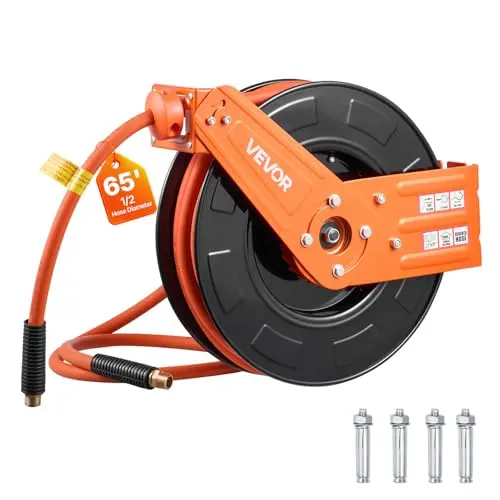
Retractable and manual air hose reels can both keep a compressed-air line controlled, but they suit different workflows. A retractable reel prioritizes quick extension and spring-assisted cleanup; a manual reel offers direct winding control and mechanical simplicity. The better choice depends on use frequency, mounting access, hose length, serviceability, and how safely the hose can travel.
Quick Answer
Retractable reels are faster for frequent daily use and keep excess hose controlled, while manual crank reels are simpler, often accommodate longer or larger hose, and give the operator direct control of rewind. Choose according to duty cycle, hose size, serviceability, mounting, and maintenance preferences.
Start by comparing the options in our Air Hose Reels collection, then use this guide to read ratings and compatibility details with a more critical eye. The broader Air Compressors section also helps place this purchase in the rest of a functional garage plan.
Compare Air Hose Reels on Amazon after you have written down your required hose inside diameter, length, working pressure, fitting size, rewind design, and mounting location. A short requirement list prevents an attractive feature from hiding a poor fit.
How retractable reels work
A spring-powered mechanism rewinds the hose and a ratchet holds selected lengths. This is convenient, but the spring, latch, guide, and swivel are service points that must match the intended duty.
A spring-retractable reel is useful when the hose is pulled out and returned frequently. The latch should hold at usable intervals, the guide should support the normal pull direction, and the rewind should remain controlled. Compare how the hose stop is adjusted and whether the model documents spring-tension and hose-replacement procedures. Never open a spring case casually; stored mechanical energy can remain even after air pressure is removed.
How manual reels work
A hand crank turns the drum, often with fewer internal mechanisms. Manual control can be useful with heavy hose or long capacity, although rewinding takes more time and requires access to the reel.
A manual crank gives the operator direct control over winding speed and hose placement. It can suit longer lines, occasional use, mobile setups, or owners who prefer fewer automatic mechanisms. The tradeoff is that the crank must remain reachable and the user must guide the hose evenly across the drum. Look for a stable frame, useful handle clearance, and a way to prevent unintended unwinding.
See current air hose reel choices on Amazon and compare the same fields across several models rather than jumping between unrelated feature lists.
Workflow differences
For short, repeated pulls around one service bay, automatic rewind reduces cleanup friction. For seasonal work, mobile carts, long runs, or deliberate hose management, a crank may be entirely adequate.
Match the style to how often the hose moves. Daily tire service, cleanup, or bench work can make fast retraction valuable. A hose used only a few times each month may not justify a spring mechanism if a manual reel stores it cleanly. Consider the full routine—pull, latch, connect, work, disconnect, bleed if required, and rewind—not only the moment the hose extends.
Capacity and pressure
Do not assume one rewind type carries more pressure. Compare the hose, swivel, drum, fittings, and frame ratings. Manual industrial reels and compact retractable reels cover very different specification ranges.
Mounting can decide the format. Retractable reels often work well on a wall or ceiling where the spring and guide align with a defined work zone. Manual reels need hand access to the crank and room for the operator to stand safely. For either style, verify permitted orientation, structural support, reel projection, guide position, and clearance from vehicles, doors, heat, sparks, and sharp edges.
A useful cross-check is the wider Air Compressors catalog, because the surrounding equipment can expose a compatibility issue that is easy to miss when the air hose reel is considered alone.
Browse more Air Hose Reels options with those system limits in mind.
Mounting and portability
Retractable models commonly live on walls or ceilings and may swivel. Manual reels are available fixed, cart-mounted, or portable. The best format keeps the hose path clear while allowing inspection and connection access.
Serviceability deserves equal weight with convenience. Check whether the hose, swivel seals, spring assembly, guide rollers, latch parts, and lead-in can be inspected or replaced using documented procedures. A fully enclosed reel looks tidy but may hide wear until service access is opened. An open-frame manual reel exposes more of the hose and drum for inspection but offers less environmental protection.
Maintenance and repair
Check whether the hose, spring cartridge, latch, swivel seals, and guide rollers are replaceable. A serviceable reel can outlast a sealed low-cost mechanism, regardless of rewind type.
Spring assistance does not remove the need for control. Guide a retractable hose back to the reel and keep people, tools, and vehicle finishes away from the coupler path. Do not release the line and allow it to snap home. With a manual reel, maintain light tension and distribute the hose evenly so loose loops do not jump off the drum or create a pinch point.
Check Air Hose Reels specifications and availability only after confirming that the listing identifies the size, rating, and included hardware clearly.
A practical choice
Estimate pulls per day, required reach, hose diameter, mounting structure, operator preference, and tolerance for maintenance. Pay for automatic rewind when it improves an actual repeated task, not merely because it looks tidier.
Compare both reel types as pressure-bearing assemblies. Hose, swivel, inlet, outlet, fittings, couplers, and lead-in must suit the compressor’s regulated pressure and the tool’s airflow. Rewind style cannot correct an undersized passage, incompatible coupler, or insufficient working-pressure rating. Isolate and depressurize the system before service according to the manufacturer’s instructions.
How to Compare a Shortlist Without Getting Distracted
Build a simple comparison table with one row for each candidate and columns for the requirements that can actually disqualify a product. Put hose inside diameter, length, working pressure, fitting size, rewind design, and mounting location first. Add dimensions, included parts, installation limits, warranty terms, and the model number. Leave a cell blank when the listing does not provide an answer; do not quietly replace missing information with an assumption. A product with fewer decorative features but complete documentation is often easier to evaluate responsibly than a feature-heavy listing that hides basic limits.
Next, separate requirements from preferences. A compatible connection, adequate rating, permitted mounting orientation, and safe operating environment are requirements. Color, extra accessories, a remote, or a particular storage style may be preferences. This order prevents a convenient feature from outweighing a mismatch that will affect every use. It also makes price comparisons fair because the remaining candidates are capable of the same core job.
Plan for Ownership, Not Just Installation Day
Think through inspection, cleaning, adjustment, storage, and eventual replacement before fixing a model to the garage. Moving parts, flexible materials, electrical contacts, seals, brackets, and fasteners can all need attention depending on the category. Service access matters. A product mounted tightly behind shelving or above a vehicle may be frustrating to inspect even if it technically fits. Keep the manual and model information where another household member can find them.
After installation, use a calm first-use test. Keep people, vehicles, and valuable tools clear, operate at a light demand, and watch the mounting, connections, controls, and working path. Stop for unexpected heat, noise, movement, leakage, binding, odor, or damaged insulation. A successful light test does not authorize exceeding the published rating; it simply confirms that assembly and basic operation appear normal before regular work begins.
A Simple Buying Checklist
Before ordering, write down the intended job, maximum demand, available space, mounting or storage location, environmental exposure, and every required connection. Confirm that the stated rating applies to the complete assembled product and to the way you will operate it. Look for understandable instructions, replacement parts where relevant, and a return path if the dimensions or interface do not match.
Do not treat customer photos or star averages as substitutes for specifications. Reviews are useful for spotting repeated usability issues—awkward latches, weak guides, confusing instructions, premature leaks, or difficult adjustment—but the model number and manual establish what the product was designed to do. Recheck the listing before purchase because sellers can combine variations on one page.
Shop Air Hose Reels on Amazon once the checklist is complete, or return to our Air Hose Reels page to compare the category in context.
Choose by Workflow, Then Check the Mechanism
A retractable reel is usually the stronger fit when quick, frequent cleanup justifies the spring and the mounting point supports a straight, controlled pull. A manual reel is attractive when direct winding, simpler mechanics, portability, or an unusually long hose matters more than automatic return. Compare the exact model’s instructions instead of assuming every reel in a format behaves the same way.
Use the air hose reel mounting guide to test the physical location and the hose material comparison to check flexibility and environment. Then return to Air Hose Reels with a written requirement for diameter, length, pressure, mounting, and rewind style.
Frequently Asked Questions
Is the most expensive air hose reel automatically the best?
No. Price can reflect materials, capacity, accessories, or brand support, but the best choice is the model whose documented limits match your job and installation without paying for features you will not use.
Can I rely on a marketplace title for sizing?
No. Titles are shortened and variations are sometimes grouped. Verify the exact model number, manual, dimensions, ratings, included fittings or hardware, and any operating limits before ordering.
How much extra capacity should I buy?
Use the manufacturer’s selection guidance and the demands of the complete system. Sensible margin can help, but arbitrary oversizing can add weight, cost, electrical demand, or awkwardness without improving the job.
What should I inspect when it arrives?
Confirm the model and rating label, examine the housing and working components for damage, inventory the parts, read the instructions, and test operation without exceeding limits before putting valuable tools or vehicles nearby.
When should I ask a professional?
Get qualified help when the installation changes fixed wiring, depends on uncertain structural support, involves code requirements, or operates near hazards that the product documentation does not clearly address.
Final Verdict
Retractable reels are faster for frequent daily use and keep excess hose controlled, while manual crank reels are simpler, often accommodate longer or larger hose, and give the operator direct control of rewind. Choose according to duty cycle, hose size, serviceability, mounting, and maintenance preferences. The winning choice is the one supported by clear documentation and installed within every stated limit. Compare the complete system, not one headline feature, and plan how the product will be inspected, stored, or serviced after the first use.
For a final side-by-side look, compare Air Hose Reels on Amazon. The link uses the exact collection-specific destination supplied for MyGarageProducts.com.