Car Battery Chargers vs Jump Starters: Which Is Best for You?
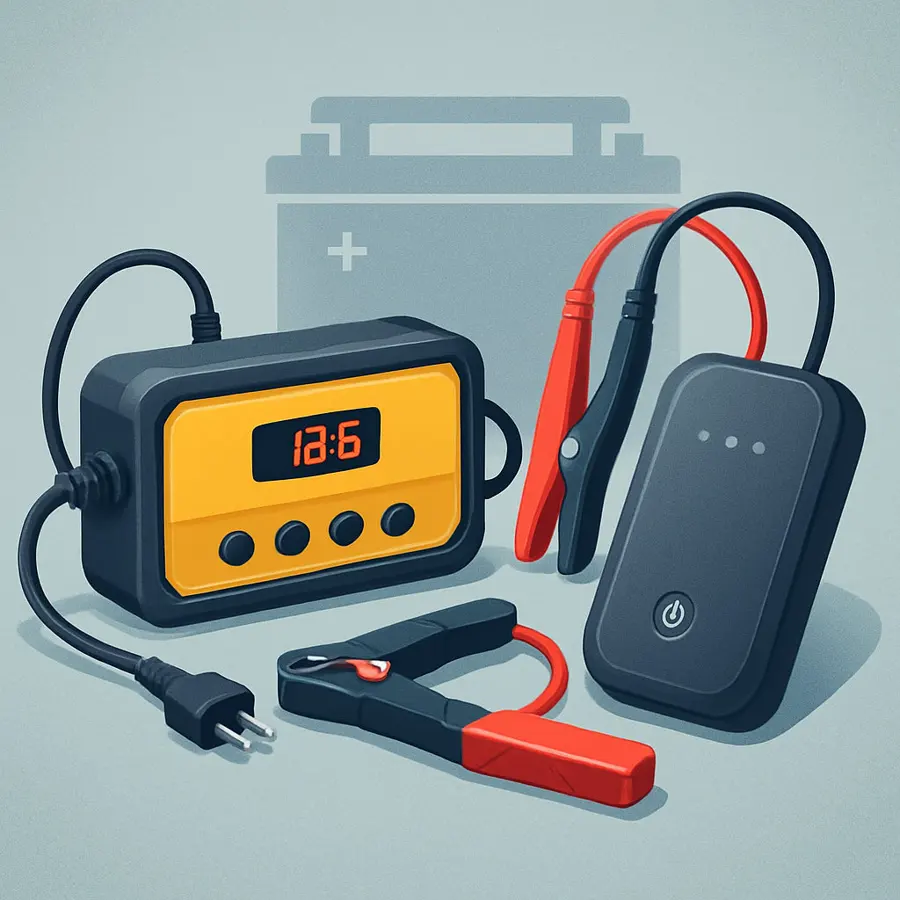
A battery charger and a jump starter are not interchangeable versions of the same tool. A charger delivers controlled energy over time to restore or maintain a compatible battery. A portable jump starter supplies a brief burst intended to help crank an engine when the vehicle battery cannot do so on its own. Choosing the wrong tool can leave the underlying battery problem unresolved, so the first question is whether you need recovery now, routine maintenance, or diagnosis.
Quick Answer
Choose a jump starter for portable emergency starting assistance. Choose a battery charger or maintainer for a vehicle that sits, a battery that needs controlled recharging, or ongoing maintenance allowed by the battery and charger manufacturers. A jump starter does not fully recharge the vehicle battery. Many households benefit from both: a compatible charger in the garage and a charged jump pack in the vehicle.
Compare the site’s car battery chargers and jump starters after checking the vehicle battery’s voltage, chemistry and manufacturer instructions.
The essential difference: time and purpose
A charger is designed to transfer energy into a battery through a managed charging process. Depending on the exact device, it may offer charging, maintenance, temperature compensation or modes for specific lead-acid or lithium chemistries. The charger’s manual must match the battery voltage and chemistry. A low-current maintainer can help offset self-discharge during storage, while a larger compatible charger can restore a discharged battery over hours.
A jump starter is designed to help the starter motor turn for a short attempt. Its internal battery is portable and connects directly at the vehicle according to the device and vehicle manuals. After a successful start, the vehicle still needs attention: the original battery may remain discharged, damaged or near the end of its service life, and the charging system may have a fault. Driving is not a guaranteed cure.
NOCO’s current GB40 support documentation, for example, explicitly distinguishes Boost jump starting from battery charging. That is a model-specific primary source, not a rule that every pack shares the same controls or battery compatibility.
When a battery charger is the better tool
The vehicle sits for weeks
Seasonal cars, motorcycles, lawn equipment and infrequently driven vehicles can lose charge while parked. A compatible maintainer can be a better solution than repeatedly waiting for the battery to become too weak to start. Confirm that the device is intended for unattended maintenance if that is the plan; do not assume every charger can remain connected indefinitely.
The battery is discharged but time is available
If the battery and vehicle are otherwise suitable for charging, a charger can restore energy more deliberately than a jump start. Follow the battery and charger instructions for connection, ventilation, mode selection and monitoring. Stop if the battery is cracked, leaking, unusually hot, frozen or otherwise outside the manual’s acceptable condition.
You need routine state-of-charge support
Short trips and long storage periods can leave a battery undercharged. A charger or maintainer addresses state of charge; a jump pack only assists at the moment of starting. If the battery repeatedly goes flat, diagnose the cause rather than treating every event as an isolated emergency.
When a jump starter is the better tool
You need to start away from an outlet
A portable pack can provide assistance in a driveway, parking lot or other location without another vehicle. Its value depends on being charged, stored within the permitted temperature range and compatible with the vehicle. Check the pack’s state of charge on a schedule and before long trips.
You want a self-contained emergency option
Traditional jumper cables require a suitable donor vehicle and correct connection to both vehicles. A jump pack removes the donor vehicle from the process. It does not remove the need to identify battery polarity, use the connection points specified by the vehicle maker, and keep clamps from touching each other.
You have a known, compatible starting problem
A jump starter can be useful when lights or accessories were left on and the battery is merely too weak to crank. It is not the right response to smoke, damaged cables, leaking electrolyte, a visibly deformed battery or an unknown electrical fault. Roadside help or qualified service is more appropriate when the condition is uncertain.
Compatibility checks before buying either tool
Start with battery voltage and chemistry. A 12-volt lead-acid starting battery, a 6-volt classic-vehicle battery and a lithium powersports battery do not automatically use the same charger or jump procedure. Read the battery label, vehicle manual and device manual. Select the exact mode only when the documentation supports it.
For jump starters, engine type and displacement are common selection inputs, but manufacturer ratings are not a substitute for the exact compatibility table. Cold temperature, battery condition and cable connection quality affect starting. For chargers, compare output current, supported battery capacity, charging modes and whether the device can maintain as well as charge.
A current BOOKOO A9 jump-starter listing on Amazon and a current VACASSO jump-starter listing illustrate how live listings present different peak-current and feature claims. Treat those as seller/manufacturer specifications to verify, not independent performance tests.
Connection and safety are product-specific
The vehicle manual controls where connections should be made. Some vehicles provide remote jump points rather than directing users to the battery terminals. The charger or jump-pack manual controls device sequence, indicator meanings, time limits and disconnection. General red-to-positive memory aids do not replace those instructions.
Work in a ventilated area away from flame, sparks and smoking. Remove jewelry that could bridge conductive points. Inspect cables and clamps before use. Do not continue if polarity or terminal identification is uncertain. A protection light or alarm is helpful, but it should not become permission to connect carelessly.
Some jump packs offer a manual-override function for batteries too low for automatic detection. On NOCO’s GB40, the manufacturer warns that manual override disables safety protection and requires particular care. Never activate an override merely because a normal start attempt failed; use it only when the exact manual authorizes it and every connection has been confirmed.
What to do after the vehicle starts
Disconnect in the order specified by the device and vehicle manuals, power the pack off if required, and secure its clamps. A successful start proves only that the engine cranked and ran. It does not establish that the battery is healthy. If the battery warning light remains on, the vehicle runs poorly, or it will not restart, seek diagnosis.
Recharge the jump pack after use. For the vehicle battery, follow the maker’s guidance on driving or charging. A proper battery and charging-system test can distinguish a discharged battery from a failing battery, parasitic draw, loose connection or alternator problem.
Which one should stay in the garage?
A charger belongs where there is safe power access, ventilation and room to route leads without creating a trip hazard. It is the better garage tool for scheduled maintenance and recovery. Review the garage power, cords and reels hub when planning the charging area, but do not use an extension cord unless the charger manual permits one of the required type and gauge.
Which one should stay in the vehicle?
A jump pack is portable, but the vehicle interior can experience severe heat and cold. Follow the pack maker’s storage-temperature limits and do not leave a damaged or swollen lithium pack in service. Store it so clamps cannot contact metal objects, and inspect its charge periodically. A current LUCKFIRE jump-starter listing can be compared with other options, with all current claims checked on Amazon.
Do you need both?
For a regularly used modern vehicle, a jump pack provides emergency portability while a smart compatible charger provides maintenance and controlled recovery. Owning both can be sensible because they solve different problems. A household with no suitable charging location may prioritize a jump pack and professional battery service. A collector or seasonal-equipment owner may rely more heavily on maintainers while still keeping an emergency pack available.
Frequently Asked Questions
Can a jump starter charge a dead car battery?
A typical jump starter is intended to assist cranking, not fully recharge the vehicle battery. Check the exact product manual. After a jump, investigate why the battery was discharged and use an appropriate charging or service process.
Can I leave a battery charger connected overnight?
Only if the exact charger is designed for that use, correctly configured for the battery and operated under the conditions in its manual. “Smart charger” is not a universal promise of unattended suitability.
Will a bigger peak-amp number always start better?
No. Published peak figures use manufacturer-specific methods and do not capture cable quality, temperature, battery condition, protection behavior or compatibility. Use the maker’s engine and battery guidance rather than ranking packs on one headline number.
What if the battery is completely flat?
Automatic jump packs may not detect a battery below their threshold. Do not improvise. Consult the exact manual, and use manual override only if expressly authorized and you understand the reduced protections. A damaged or uncertain battery needs professional help.
Can I use either device on an electric vehicle?
Electric and hybrid vehicles may have a low-voltage auxiliary battery and model-specific procedures, but their high-voltage traction systems require specialized handling. Follow the vehicle manufacturer’s manual. Do not connect equipment to a high-voltage battery.
Final Verdict
A charger maintains or restores a compatible battery over time; a jump starter provides short-term starting assistance. Buy for the actual problem, verify voltage and chemistry, and follow both manuals. For emergency-pack technique, continue to the step-by-step jump-starter guide. The garage equipment and car care hub connects both categories to the broader vehicle-care setup.